Chasing Shadows: Guided by Light
Updated: Aug 26
Light is direction. It commands attention, shapes emotion, and fills the gap between what you see and what you feel. We created Chasing Shadows to show that light alone can drive a narrative.
The project started as a concept for a stylised pursuit and grew into a quiet, cinematic study of atmosphere. The seed came from a compositing supervisor's demo of a painterly Nuke effect, built with BlinkScript, that stuck with us. That video sent us looking for the same look in other tools. The idea took its final shape once we found the piece of music to anchor it, in the spirit of League of Legends' cinematic trailers.
We had no rigid external benchmark to follow, so we leaned on our own experience. We gave ourselves room to explore, and kept the discipline to stay in control of it.
Working Without a Blueprint
For Grace, our Lighting & Compositing Lead, working without a traditional reference blueprint meant more creative freedom.
“Without a predetermined benchmark, the objective shifted from replication to innovation. It was an invitation to test unconventional styles and push the boundaries of what our tools could do.”
Using Unreal Engine and Nuke together, Grace treated lighting as a storytelling device. Colour carried the emotional undercurrent, and contrast carried the tension.
In the cathedral sequence, light acts as a character. Recreating the painterly effect meant building a Kuwahara filter from scratch in Unreal Engine using a custom code within the post process volume, a technique the team hadn't used inside UE before.
That gap sent us through tutorials and forum threads, and reinforced how much technical grounding an artistic vision depends on. One of the best moments in the sequence came by accident: pairing the painterly Kuwahara look with warm, jovial lighting in the cathedral shot, then letting a burst of confetti fall through the frame. It wasn't planned, but it lifted the whole shot.
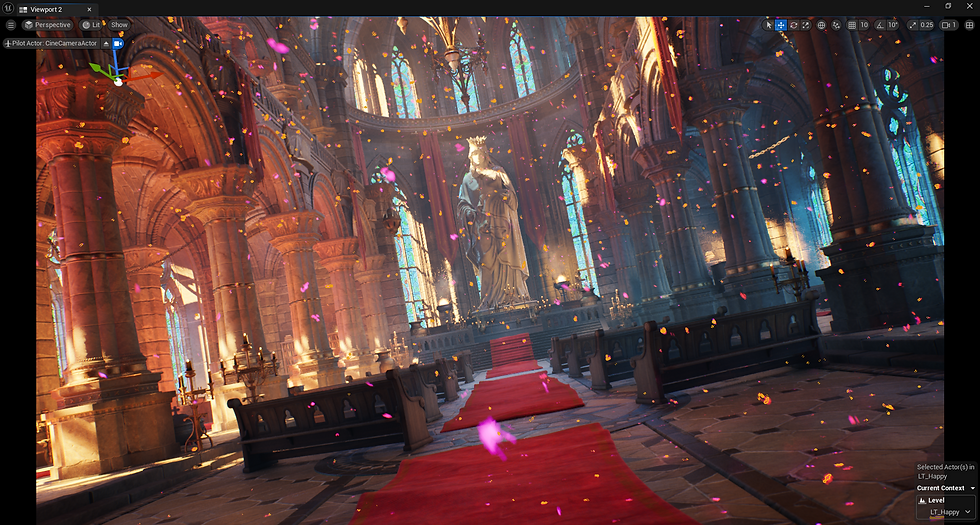
The painterly texture, the subtle colour shifts, and the deliberate shadow placement together built a visual rhythm meant to hold a viewer's gaze, which matters in digital spaces where attention is scarce. That rhythm came from a week of iterative experimentation, fine-tuning texture response and camera movement until the atmosphere felt alive.
Harmony in Motion
A convincing atmosphere needs close coordination between departments. Joseph, our Animation Supervisor, built the piece from the ground up, drawing on the whole team's expertise along the way.
“Steering this piece independently from scratch allowed us to see exactly how far we could stretch our creative and technical boundaries.”
Animation lived in Maya, and rendering happened in Unreal. Joseph calibrated the camera paths and character pacing so the motion supported the lighting instead of pulling focus from it. We held the animation back on purpose, to give the light room to breathe, which gave us a choreography where movement and illumination work together rather than compete.
That balance took real cross-team collaboration. The modelling team adjusted set-dressing to catch light more dramatically, and the animation team smoothed camera trajectories to protect immersion. As Joseph puts it:
“True leverage comes from diverse expertise. The team's cross-disciplinary feedback directly sharpened the final execution.”
Cinematography was the other skill this project tested, since making the storytelling read clearly, shot by shot, took as much research as the technical problem-solving did.
Experience the Work
The Team
• 3D Artist (Modeling Enhancements) Phua Jia Jia | • Intermediate 3D Artist Sylvia Seow Hui Yee | • Animation Lead (Cinematography & Animation) Joseph Teh Yee Xiang |
• Lighting & Compositing Lead Grace Foo Jehn Wei | • Reference Asset (Modular Cathedral) Hivemind
The Tools

• Lighting & Compositing Nuke
• Real-Time Engine Unreal Engine (Blinkscript Kuwahara Filter)
• Shader Development Blinkscript


Comments