
MiRETH: Built on Details
Most of our projects begin with a spark — a whisper of an idea that with each detail grows into something alive. This one began deep in the woods.
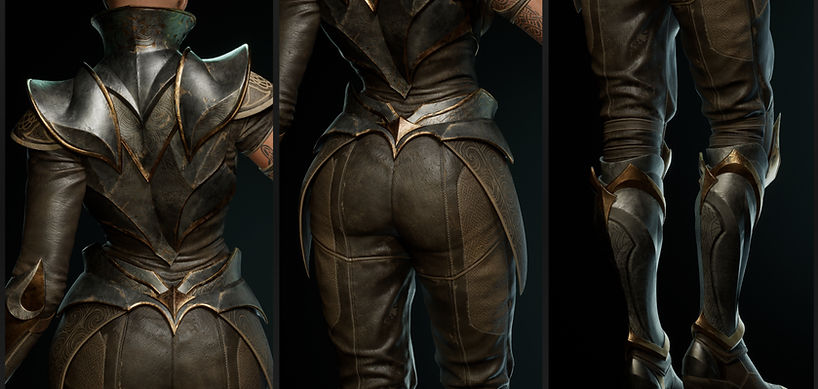
Mireth was never designed to impress at first glance alone. She was built to hold up under a second look — and a third. From the beginning, her story demanded that every surface, mark, and material feel intentional, as though it had been shaped by time, use, and belief.
Her origins guided everything. Raised in the woods by elemental whisperers and shaped by the quiet discipline of survival, Mireth’s design needed to reflect restraint as much as strength. Her golden bracers, engraved with protective sigils gifted by the elven council, became a focal point — not because they shine, but because they mean something. The engravings aren’t decorative flourishes; they’re functional symbols, worn smooth in places where her hands would naturally move.
"Detail" became our language.

We spent time asking small but important questions. Where would the armor scuff first? Which edges would dull with use? How would metal weather in a life spent outdoors? The goal wasn’t perfection — it was believability. Armor that felt lived in, repaired, trusted.
As Milad, our Senior 3D Character Artist, explains:
“Finding the balance between magical details and practical design was tricky. I didn’t want the armor to look like a costume, but I also didn’t want to lose the sense of mysticism.”
That tension shaped every decision. Magical elements were woven subtly into the materials themselves — in the way light catches an edge, in the faint glow of engraved lines, in the contrast between polished gold and worn surfaces. The magic was never loud. It was embedded.
The process unfolded slowly, by design. Over four months, Mireth evolved through countless passes using Autodesk Maya, ZBrush, Substance Painter, and Unreal Engine. Each tool allowed us to push a different layer of detail — from sculpted forms and micro-wear to material response and lighting. The final result wasn’t about adding more, but knowing when to stop.
And throughout it all, collaboration sharpened the work. Feedback acted as a lens, helping us see what felt honest and what felt indulgent.
Milad reflects on that process simply:
“Their feedback was like a reality check — in the best way.”
In the end, Mireth stands as a reminder of how we work at Fuloso. That craft lives in restraint. That fantasy becomes believable through detail. And that the most powerful designs aren’t defined by what’s added — but by what’s considered.
Because when every detail has a reason to exist, the character does too.